The Inner Limit
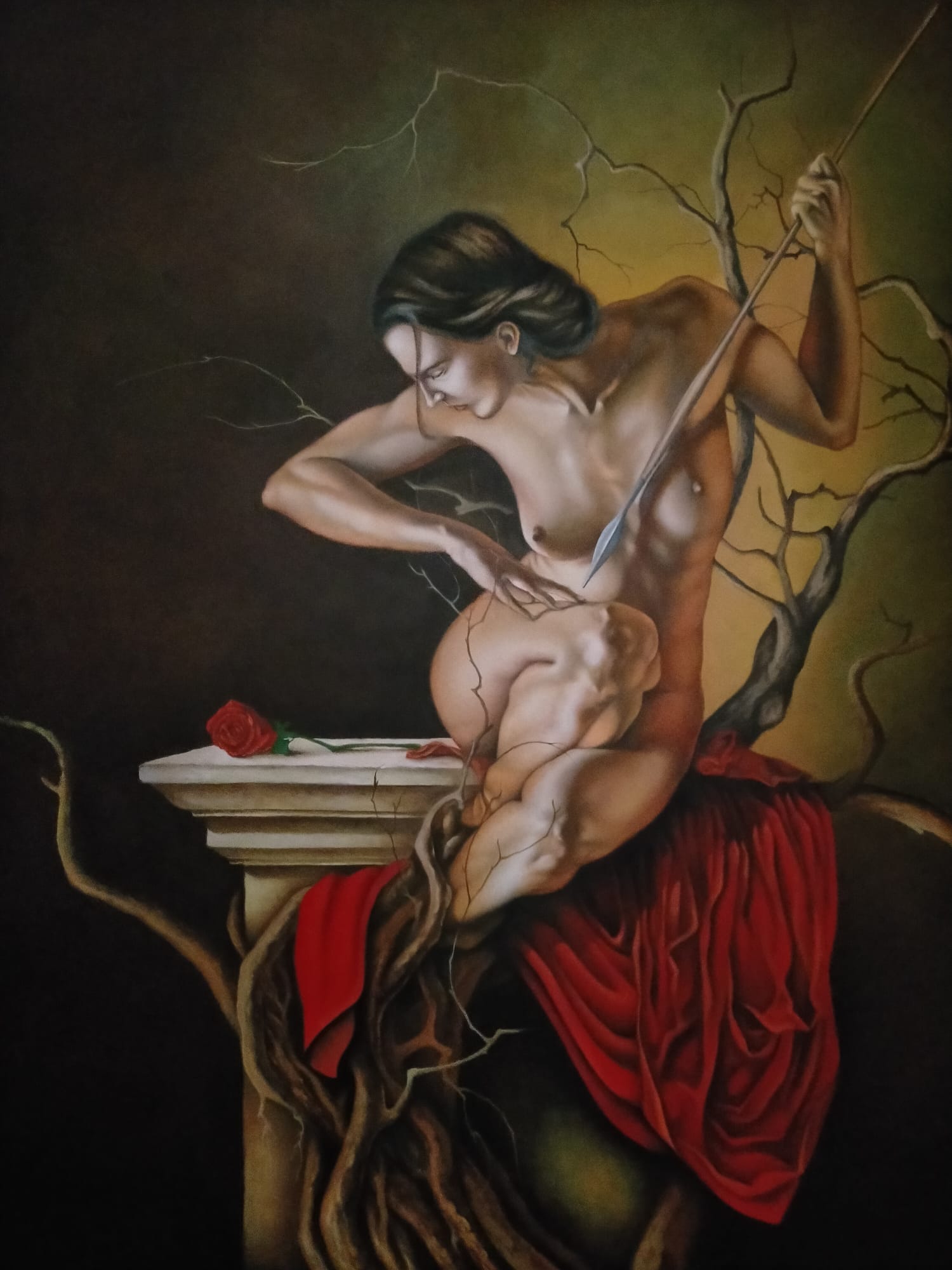
The Inner Limit represents the exact moment in which the human being confronts the most violent and silent threshold: the one within. The female figure, naked and vulnerable, does not struggle against an external force, but opens herself—literally—to explore what both constitutes and wounds her. The spear is not a weapon of attack, but an instrument of revelation: it pierces the flesh as one crosses an inner boundary that has always been there, latent.
The body appears stretched between two opposing impulses: the desire for self-knowledge and the inevitable pain it entails. The roots that emerge and coil around the anatomy suggest that the inner world is not abstract, but organic, ancestral, and inescapably tied to origin. There is no escape from what we are: the inner self grows, branches out, and claims its space.
The red rose, a classic symbol of beauty, love, and sacrifice, rests upon an almost funerary or ritual structure. It is offered to no one but the act of introspection itself. It is both reward and price. The red drapery reinforces this idea of flesh, blood, and solemnity, reminding us that inner knowledge always demands a loss.
The face, inclined and focused, expresses not horror but determination. Here, the limit is not physical pain, but the point at which the individual decides how far they are willing to look within. The Inner Limit does not speak of self-destruction, but of an extreme form of courage: the courage to pierce the illusion of wholeness and discover that the human being is, in essence, a conscious wound.
The painting suggests that the true limit is not found in the body, in morality, or in the external world, but in the act of accepting what dwells beneath the skin. To cross it is an almost sacred gesture. Not to do so, a silent condemnation.
Details
- Technique: Oil on canvas.
- Dimensions: 100 x 120 cm.
- Year: 2022
- Availability: Yes
The Inner Limit
The Inner Limit represents the exact moment in which the human being confronts the most violent and silent threshold: the one within. The female figure, naked and vulnerable, does not struggle against an external force, but opens herself—literally—to explore what both constitutes and wounds her. The spear is not a weapon of attack, but an instrument of revelation: it pierces the flesh as one crosses an inner boundary that has always been there, latent.
The body appears stretched between two opposing impulses: the desire for self-knowledge and the inevitable pain it entails. The roots that emerge and coil around the anatomy suggest that the inner world is not abstract, but organic, ancestral, and inescapably tied to origin. There is no escape from what we are: the inner self grows, branches out, and claims its space.
The red rose, a classic symbol of beauty, love, and sacrifice, rests upon an almost funerary or ritual structure. It is offered to no one but the act of introspection itself. It is both reward and price. The red drapery reinforces this idea of flesh, blood, and solemnity, reminding us that inner knowledge always demands a loss.
The face, inclined and focused, expresses not horror but determination. Here, the limit is not physical pain, but the point at which the individual decides how far they are willing to look within. The Inner Limit does not speak of self-destruction, but of an extreme form of courage: the courage to pierce the illusion of wholeness and discover that the human being is, in essence, a conscious wound.
The painting suggests that the true limit is not found in the body, in morality, or in the external world, but in the act of accepting what dwells beneath the skin. To cross it is an almost sacred gesture. Not to do so, a silent condemnation.
Details
- Technique: Oil on canvas.
- Dimensions: 120 x 100 cm.
- Year: 2022
- Availability: Yes
Related works
The following works establish a conceptual and formal dialogue with the main piece, addressing related concerns through different pictorial resolutions. Together, they expand the project’s discursive framework and propose a more complex and nuanced reading of the body of work.